by Zhu Hongzhou
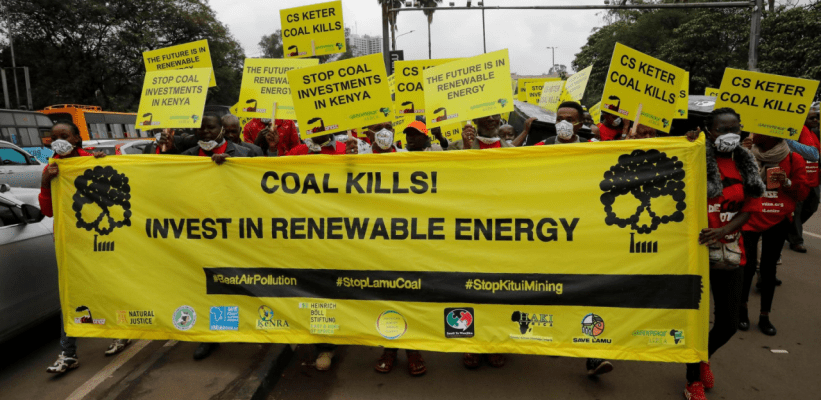
We’re now old, but we inherited a clean and healthy environment from our fathers, and it’s our duty to give our children a clean and healthy environment as well,” said Mohammed Mbwana, the vice-chair of Save Lamu, an environmental protection NGO based in Lamu, Kenya.[1]
The emission of fuel combustion has been a long-time problem for the health of the local community. It is also a threat to the local marine ecosystems. The released toxins may jeopardize thousands of fish and shellfish, which will hit the development of the fishing industry and affect the livelihoods of local fishermen.
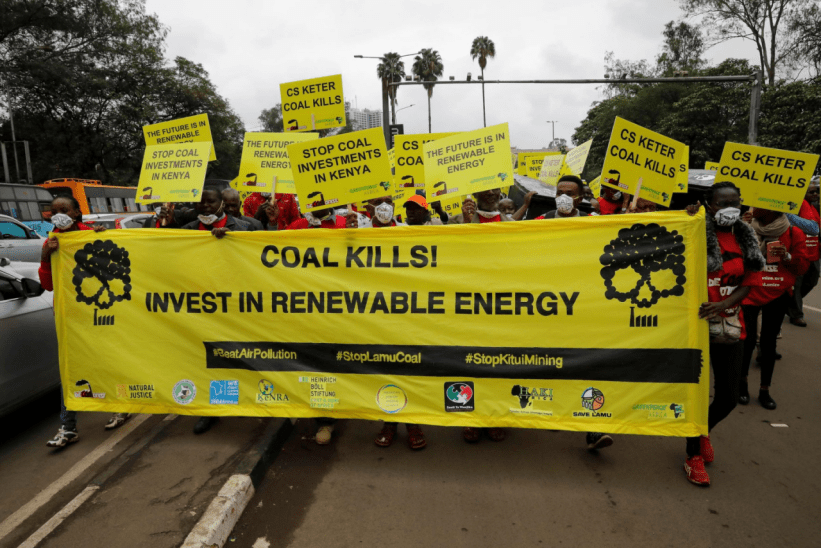
In June 2019, Kenya National Environment Tribunal canceled the license of the Lamu coal project. Subsequently, The African Development Bank and the Chinese Bank ICBC pulled out of the project. As a result, the first coal plant in East Africa has been scuttled. This is not the only victory, under the background of the Paris Agreement, many countries are proactively seeking energy transmission and abandoning traditional energy projects, such as coal and oil.
When “the most important” makes “the most difficult” decision
The international community has been calling on China to suspend the investment in coal power for a long time. At the United Nations General Assembly on September 21st this year, China finally made its promise. President Xi Jinping announced that China will not build any coal-fired projects abroad anymore. “China will step up support for other developing countries in developing green and low-carbon energy, and will not build new coal-fired power projects abroad.”[2]
This announcement manifests China’s determination on leading the world’s environmental protection as well the tackle aggravated climate change conditions and fulfillment of sustainable development goals. The decision was made after Korea and Japan also had abandoned their coal-fire project abroad, China is the third who took the responsibility of reducing its carbon emission outside the territory.
“As important investors in overseas coal power projects, China, Japan, and South Korea, their actions are of great significance to the trend of global fossil energy. China’s decision to stop new overseas coal power generation, as well as the coal withdrawal pledges made by South Korea and Japan this year, all indicate that the withdrawal of investment in fossil fuels is accelerating on a global scale.” Jennifer Morgan, the Greenpeace Global Director said.[4]
However, unlike the other two countries, China had invested a total of $50 billion in overseas coal power generation, with plants coal power capacity of 56.135GW, the largest among the three countries, and somehow the most important and difficult one to make the same decision.
As China announces the pledge, it will lead other countries to carry out energy transitions and invest in more renewable energy projects. China’s overseas investment in renewable energy projects has surpassed the investment in overseas fossil energy power generation projects in 2020, which will help achieve net-zero emissions in 2050 that Paris Agreement mentioned.
A “victory” for activists, but not for everyone?
The Kenya activists see China’s commitment as a big achievement of their actions, and call it a win for all community groups and activists who opposed the projects which had posed serious environmental threats.[3]
This activists-claimed victory, despite the profound positive impact that might be brought, louder voices have been raised about the possible queries, losses, and obstructions with great interests.
The stakeholders, investors, entrepreneurs, and other career-related employees are devastated toward the future. Though the policies have not been implemented yet, most of the industry insiders are not able to be optimistic enough to claim that they are not going to switch to another energy field. It is because 50% of the global investment to the coal project came from China, more than 20 countries would have no choice but suspend the program, 44 plants would be affected which also include the few projects which just finish or start their financing progress.[5]According to Reuter’s report, more than 50 billion capitals would have gone for nothing if China keeps her words.[6]
In addition, with the warm welcomes from the environmentalist all around the world, lots of people are hoping and seeking a more detailed and clearer announcement from the government, since president Xi only mentioned the pledge in one sentence in the pre-recorded video. Li Shuo, a senior adviser at Greenpeace East Asia said: “Many questions can be asked about the announcement, including whether it will be implemented immediately, does it include only financing or also construction, does it apply to state actors only, will it lead to a similar moratorium on fossil fuels?”[7]
Does renewable energy have the answer to all?
The figure shows that, until the day of the announcement, China invested “zero” into the overseas coal-fired projects within 2021, according to the Center for Energy and Clean Air (CECA) research report.[8] In addition, by taking advantage of the OBOR initiative, despite the pandemic, China still provided financial supports to the renewable energy exploitation, which accounted for more than half of the total amount of the investment into the energy projects.
In Kenya, though there are events like the one that happened in Lamu, the Chinese government had also helped to build renewable energy projects there. Garissa solar plant, which was built by China Jiangxi Corporation for International Economic and Technical Co-operation (CJIC) and started to operate in 2019, can supply almost half of the Kenya population with another half the price compare to the price of electricity which generated by coals. [9]
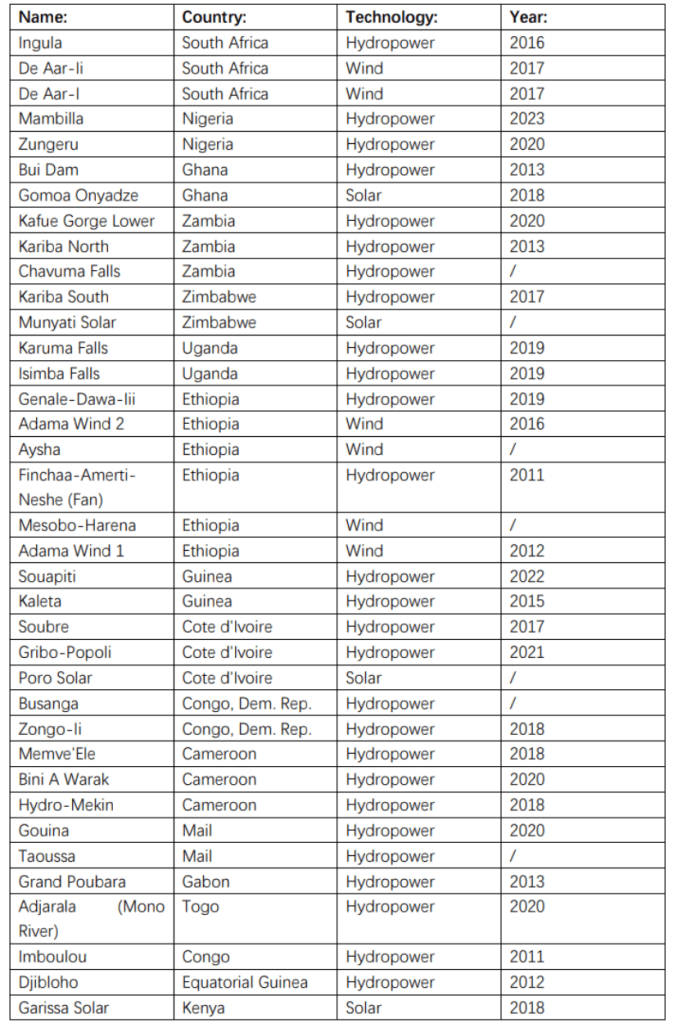
The Boston University-based China’s Global Energy Finance Database displays the investment data from the China Development Bank and Export-Import Bank of China, it shows that although the fund on coal has decreased, the investment in liquefied natural gas (LNG)/gas, and hydropower still take a large proportion.[10]
Compared with wind and solar, they are not that eco-friendly. Take LNG as an example, during extraction, processing, and transport, it will cause leakage of methane, the main component of LNG. During combustion, methane will escape if the engine cannot fully burn LNG. As another greenhouse gas that has a much stronger greenhouse effect than carbon dioxide, methane will not contribute to reducing climate warming. There is no evidence to show China would stop investing in such industries.
Covid knocks the buzzing projects cold
In the short term, the influence caused by Covid – 19 also cannot be ignored. Since China has travel restrictions and a strict quarantine policy, it is difficult for investors to conduct field trips. New project development can drag on for a long time. Update guidelines from many Chinese Embassies in Africa have rigorous requirements for people who come to China, most of the Embassies suggest “Non-essential, non-emergency, don’t travel”. The embassies and consulates in Nigeria reminded people to depart from Nigeria on commercial flights to China have to quarantine 21 days in advance. [11]
On the other side, the measures such as the closure of borders, total or partial lockdown, ban on international travels (including departure and arrivals) taken by Africa countries also complicate the issue. For the projects have already under construction, when they can be completed is still unknown. China’s DongFang Electric corporation started to build a 120MW wind park in Ethiopia in May 2018, and it was estimated to finish within 18 months.[12] However, the construction work has in halted since Ethiopia had shut down its border to avoid the Covid – 19 outbreak in late March last year. As a result, this program postpones until the end of 2022.[13]
Meanwhile, due to China’s zero-tolerance strategy, some Chinese ports have to temporarily stop operation. In August, the world’s third-largest container port – Ningbo port was closed for control, involving about 2,000 front-line workers, and operations at the terminal were halted as one worker infected with the coronavirus. A few months ago, Shenzhen Yantian port transportation stalled because of the pandemic as well. The global supply chain is facing challenges. There is no idea about when the port closure will happen again, but China as the main producer of solar photovoltaic panels and turbines, supply chain disruptions can result in some projects cannot being completed on time and bring cost increase.
The Nigerian off-grid energy impact investing company All-On relief $500,000 fund to four renewable energy companies to face Covid -19 emergency, [14]this is a very rare case. In fact throughout the African countries, most countries do not have specific interventions for the renewable energy sector if they have it just some short-term policies like fiscal incentives.
China has not developed a long-term cooperation mechanism with African countries which is not good news for private sectors as there is no clear signal to invest. Notably, before the pandemic debt level has increased sharply in sub-Saharan Africa. Public debt boost more than 6% points take up 58% of GDP in 2020.[15]Investments made in such a context is likely to be at great risk of non-recovery of funds.
But the enthusiasm won’t drift away
However, we cannot unnecessarily ignore the point of success of the Chinese renewable energy industry.
The second China-Africa Economic and Trade Expo has opened on September 26th this year, representatives from different countries on two continents talked about the future of energy projects in Africa. “Mozambique is looking forward to extending its generating capacity by at least 600 megawatts,” said Maria Gustava,[16] Ambassador of Mozambique to China at the event. As she wished, lots of Chinese firms claimed that they have the thought of cooperation and some even signed the contracts during the forum.
It seems that the enthusiasm of the cooperation with Chinese energy firms from Africa will never drift away. As contents above, Chinese abroad investment into renewable and clean energy escalated years by years, and it is already the main investment subject in the energy field.
Besides, no matter in solar power, wind power, hydropower, or nuclear power, Chinese firms always be the bellwether of the industry and owned exclusively advanced technology which is on a par with the US. For instance, in the polycrystalline silicon(PS) and solar photovoltaic (PV) sector, which the most important units that compose the solar panel, Chinese firms have an extremely advanced status in international society—-nine of the ten most top suppliers are Chinese firms for the PS while for PV, China Sunshine Energy, Huawei rank parallelly with China Sunshine Energy, at a position of second in the world and the total exports amounted to $2.759 billion. As a result, by the end of 2020, China’s total installed PV capacity reached 253 gigawatts, ranking first in the world and more than three times that of the United States.[17]
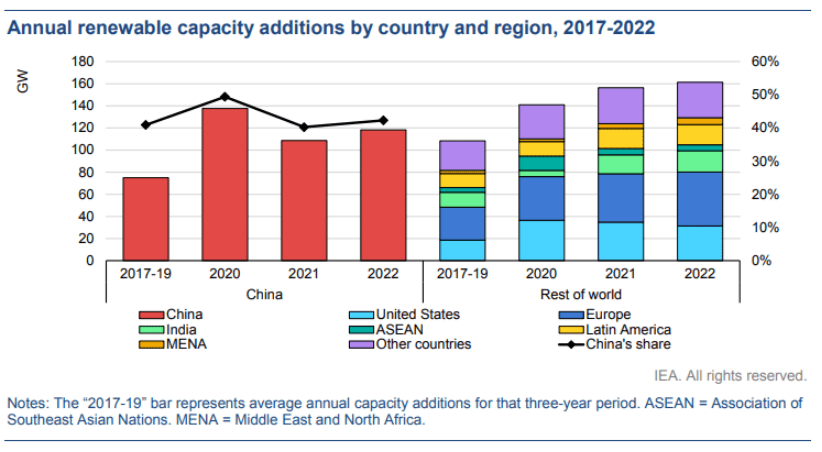
In a rather large graph, last year, China was responsible for half of the global renewable energy capacity which also constitute at least 40% for 3 years in a row previously. And China, itself alone dedicated over 80% of the increase in annual installations from 2019 to 2020. By making use of its world-leading technology, despite the phaseout of subsidies last year for PV projects, there were still an estimated 40 GW of subsidy-free developments; Despite an overall lower annual global market activity, Chinese offshore wind capacity accounted for 60% of the additions of the global value.
The 14th five-year plan, Chinese development instruction until 2025, have already contracted the extension of solar and wind projects in, it is expected that China would hold a leading position in the international renewable energy future progress while complying with the national carbon peak and neutral goal at 2040 and 2060 respectively. [18]China can regard these previously built energy institutions as their strong bases for their future development in the very content, its reputations and dominant position is incomparable to other countries.
Wait and see, eagarly
In addition, Africa, the continent itself has a great unexploited value with renewable energy for reasons ranging from lack of finance and underdeveloped grid facilities to insolvent off-takers and insufficient governance capacities. With the rapid economic growth in Africa, its demand for energy extended even further. There are about 600 million people in Africa, who do not have access to electricity, and approximately 730 million people have a heavy reliance on traditional uses of biomass.[19]Chinese firms can easily get used to the opportunity to develop their future thereby using its greatly advanced technology to grab a piece of cake from the other countries that also see the potential in Africa.
In accordance with Global data, an international big data collected institution found out that among the 242 power projects in Africa, 69 of them are contracted under China’s name with a combined value of US$78.1 billion, and those projects are expected to produce 53.3GW of generating capacity, nearly one-third of the global value, at 2030. With the loan supported by the Chinese government, companies such as China Gezhouba Group and the Sinohydro Corporation, have the chance to take on a leading role in international dam building.[20]
After all, the pledge is still resembled as a drop of pearl in deep water, whether it is a glass ball or valuable jewelry remain to be a question mark. We need to wait for fairly a period of time to see how the post-pandemic era would, somehow, lead the Chinese energy industry to a new development direction and affect the implementation of the promise in the future. However, with no doubt, the world is eagarly looking forward the country to taking on the responsibility as a great international power and co-construct a rather sustainable and promising earth.
References:
[1]OPINION: China’s plan to help build Kenya’s first coal plant has been stopped—for now,
https://qz.com/africa/1653947/kenya-court-stops-china-backed-lamu-coal-plant-project/
[2] https://www.ghub.org/climate-wire-286/
[3] https://allafrica.com/stories/202109230853.html
[4]OPINION: Greenpeace’s response: China promises to “no longer build overseas coal power projects” https://min.news/en/economy/81c1e365da9e62fb8e728abdba57637a.html
[5] https://chinadialogue.net/zh/4/73239/
[7] https://www.bbc.com/news/world-asia-china-58647481
[8] https://energyandcleanair.org/wp/wp-content/uploads/2021/06/CH-Overseas-Coal-Briefing.pdf
[10] https://www.bu.edu/cgef/?lang=en#/all/Country
[11] http://ng.china-embassy.org/chn/sgxx/gdxw/t1899165.htm
[12] http://www.xinhuanet.com//english/2017-05/18/c_136295391.htm
[13] https://global.chinadaily.com.cn/a/202107/31/WS6104cdc7a310efa1bd665b55.html
[16] https://hn.rednet.cn/content/2021/09/28/10245372.html
[17] https://xueqiu.com/1438272693/181593793
[20] https://www.power-technology.com/comment/chinese-investment-in-africa-2019/
 Global Impacts